[AI] Asmarino Independent

  • Create an account
    *
    *
    *
    *
    *
    Fields marked with an asterisk (*) are required.
You are here: Home News Locked-up and tortured for being a journalist
Locked-up and tortured for being a journalist

Write e-mail Print

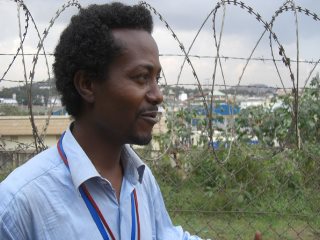
Mr Embye, an Eritrean journalist : Locked-up and tortured for being a journalistKampala

Yonas Embye talks without pause for breath. His ideas are fired scattergun-style, revealing insights from his multiple personalities – journalist, torture victim, humanitarian worker, escapee extraordinaire. But his message is clear. “I must express myself,” he says, shifting restlessly. “Sometimes I cannot sleep because I have to get the word out about my colleagues back home.”

Mr Embye is an Eritrean journalist that says he escaped from years in jail, incarcerated along with thousands of independent media workers, former ministers, political activists and minority faith practitioners, according to Amnesty International and other human rights organisations. Eritrea’s President Issayas Afewerki does not tolerate dissent: He has ruled a one-party State without elections since Eritrea’s Independence in 1993 and Eritrea is the only African country to have no privately-owned news media.

International non-governmental organisation Reporters Without Boarders (RWB) says about 26 journalists and two media workers are currently held in Eritrea, which now ranks worst in the world along with China and Iran.

Human Rights Watch said in a 2009 report that “Eritrea has become one of the most closed and repressive states in the world.”

Embye’s story

Mr Embye has an indefatigable drive to tell his story. He was working as a journalist for Admas newspaper from 1999, writing stories about the growing suppression of an active political, cultural and professional expression that had hoped to flourish after independence. Mr Embye’s focus was the new constitution, which the government refused to publish. “Without a constitution you can’t ensure your rights, or hold anybody to account,” said Mr Embye.

At the end of the 1990s there was some media freedom, but after a devastating military conflict with Ethiopia, and with global attention on the 9/11 attack on New York, Mr Aferwerki clamped down.

In September 2001 several government officials, journalists and other government critics were arrested without warning and Mr Embye says he was caught up in the detentions. “I was on my way to work with my laptop and I was picked up and taken to a prison. I was there for three months. I couldn’t see my family, or lawyers... I was investigated by national security and they tried to make us admit that we were saboteurs against the motherland.”
He says he was tortured.

“Everyday at 5am they would put me in freezing water. They’d tie wood under my knees and hang me upside down; beat my feet and my hands. There was so much shock.” “But I am strong. I never signed,” he said, puffing his chest. “I knew my family would be in danger if I confessed. I also did it for all of the journalism profession.”

Amnesty’s research on Eritrean prisons supports Mr Embye’s testimony, saying prisoners are ‘regularly’ tortured. It says at least one journalist has died in jail. Last month RWB wrote to Manfred Nowak, UN Special Rapporteur on Torture, insisting “the conditions in which Eritrean detainees are held are among the most disturbing in the world.”
In 2005, Mr Embye says he was relocated to another prison in the desert of Western Eritrea where he decided to escape.

Dumped, abandoned

“I told the other prisoners the world did not care because there was no evidence about us. We were the witness and had to tell the outside.” The prisoners systematically used one section of the perimeter wall as a latrine to weaken the concrete and after several months used a spoon and a fork to dig through.

He says he and two companions crossed the desert in three days, dodging sand snakes and scorpions. By luck, they reached the border with Sudan, where Yonas was granted asylum. He spent the next four years volunteering for humanitarian agencies and researching human rights abuses in war-ravaged Darfur.

“I felt human and I wanted to help fellow humans,” he enthuses. But his activities made him vulnerable to persecution from the Sudanese authorities. They were feeling the heat from the International Criminal Court which was mounting a case against Sudan’s president Omar el Bashir on charges of war crimes and crimes against humanity in Darfur, from evidence they’d received from people such as Mr Embye.

So he decided to flee again and travelled to Uganda in November 2009, where he has been seeking permanent asylum. He has just been granted a second three months extension of stay while the government decides upon his fate and has been relying on the good-will of fellow Eritreans and the Catholic Church for food and shelter.


Add comment

Security code
Refresh

Asmarino

Eritrean Youth Call for Friday Protests Inside the Country

Eritrean Youth Call for Friday Protests Inside the Country

January 31, 2012 - Eritrean youth across the globe are calling their counterparts inside the country to demonstrate their outrage at the human and democratic rights abuses by emptying the streets in towns and cities throughout the country every Friday evening starting Friday 3rd of February. The call that has been transmitted through electronic communication and social media has so far been received positively by Eritreans inside the country.

Read more...

Eritrean-Ethiopian Frienship Forum

Eritrean-Ethiopian Frienship Forum

Ethiopian & Eritrean Friendship Forum (EEFF) is holding its fourth annual conference on March 24th, 2012. Building on last year’s success, this year’s theme is "Healing Past Wounds -- Building Our Future Together", a critical idea to focus on in this increasingly competitive global economy.

We are sending this announcement to the wider Ethiopian and Eritrean community for two reasons:
- to invite as many people as possible to attend the conference. Be part of the solution!
- to invite thought leaders to share their views as panelists.


Read more...

The son of a Priest thinks that God is his Uncle.

The son of a Priest thinks that God is his Uncle.

The demonstration called by Mr.  Kyriakakos et.al is not an isolated incident.  Even though on the surface it appears that it was in reaction to the WFP articles, but none the less it is not.  It was part and parcel of the series of demonstrations and seminars that suddenly erupted in the month of December 2011 called “Hizbawi Mekete” (National Rebuff) to object the sanctions on Eritrea that was being debated at the UNSC and show to the international community that the Eritrean government enjoys the full support of its people.  The instruction to demonstrate and hold public meetings and seminars was issued by the office of Mr. Yemane Gebreab, political advisor to the President of Eritrea and in charge of the “Hizbawi Mekete”.

Read more...

Melbourne Rally 2012: For How Long Can You Remain Silent in the Face of Oppression?

Melbourne Rally 2012: For How Long Can You Remain Silent in the Face of Oppression?

As in previous years, we call on the Diaspora communities living in the free world that have chosen to be silent in the face of oppression and the ever growing injustice committed against the Eritrean people to fight for the people's rights. We remind you that you are morally obliged and duty bound to speak for the Eritrean people and to stand-up against injustice. We remind you the freedom that you enjoy are the outcomes of sacrifices paid by people who believed in liberty, freedom, justice and democracy. So, why don’t you demand for the Eritrean people the same civil rights that you are relishing? We encourage you to be part of the struggle for democratic change?


Read more...

Support AI

Plea by Paris lawyer on behalf of journalists imprisoned in Eritrea: “Beautiful Asmara, denied its Jasmine Revolution”

Plea by Paris lawyer on behalf of journalists imprisoned in Eritrea: “Beautiful Asmara, denied its Jasmine Revolution”

Prisca Orsonneau, a Paris bar member and coordinator of the Reporters Without Borders Legal Committee, participated in the final of the Caen International Human Rights Advocacy Competition on 29 January. Her speech, entitled “Beautiful Asmara, denied its Jasmine Revolution,” was a plea on behalf of Swedish-Eritrean journalist Dawit Isaac and other journalists who, like him, have been held for more than ten years in Eritrea without being brought to trial.

Read more...

Norway-Eritrea deal on the cards

Norway-Eritrea deal on the cards

The Norwegian government will shortly be signing an agreement enabling forced return of rejected Eritrean asylum seekers, according to reports. ...

The UN High Commissioner for Refugees (UNHCR) and the UN High Commissioner for Human Rights (OHCHR) have both advised against return.

Human rights organisations report widespread physical abuse of political opponents. A prominent Norwegian researchers classifies the country as “one of the most totalitarian and militarised in the world,” reports Klassekampen.

Read more...

Ethiopian tourist abductions and attacks blamed on Eritrea

Ethiopian tourist abductions and attacks blamed on Eritrea

(eTN) - Eritrea’s dictatorial and radical regime has been fingered by Eritrean opposition groups, Ethiopian, and other international sources for alleged complicity in the recent spate of attacks on foreign tourists and abductions, as Ethiopian rebels granted safe havens inside Eritrea are suspected to have carried out the attacks.

A source in Addis Ababa, insisting on anonymity – not a strange demand considering the zipped-up attitude of the entire country vis-a-vis even friendly media – suggested that the rebels were aiming to disrupt the growing tourism business in Ethiopia to harm the country’ economy ...

Picture: Member of European tourist group attacked by terrorists from Eritrea

Read more...

Human Rights Watch World Report 2012: Eritrea

Human Rights Watch World Report 2012: Eritrea

Since September 2001 or even before, Eritreans from all walks of life—government officials, leaders of government-controlled labor unions, businesspeople, journalists, and national service evaders or escapees—have been jailed for explicit or inferred opposition to President Isaias Afwerki and his policies. The number of Eritreans jailed for such opposition is difficult to confirm, but ranges from 5,000 to 10,000, excluding national service evaders and deserters, who may number tens of thousands more. Twenty prominent critics and journalists have been held in incommunicado isolation for a decade; nine are feared dead.

Read more...

In 2012 Worldwide Press Freedom Index Eritrea Is Last: 179th

In 2012 Worldwide Press Freedom Index Eritrea Is Last: 179th

Finally, Eritrea (179th) came last in the index for the fifth year running. Freedom of opinion, like all the other freedoms, does not exist under the totalitarian dictatorship that President Issaias Afeworki has imposed on this Horn of Africa country. At least 30 journalists are currently detained in appalling conditions. Some have been held for more than 10 years.

At the other end of the index, several African countries made significant progress or showed that respect for freedom of information has taken a firm hold in their societies.

Read more...

Swedish court finds Tedros Issak guilty of unlawful threat against Meron Estifanos

Swedish court finds Tedros Issak guilty of unlawful threat against Meron Estifanos

Meron Estefanos appeared as a speaker at a Book Fair in Gothenburg on the day when the incident took place. She has written about Eritrea and about the family of Isaak. Meron Estefanos and Teodros Isaak were not personally acquainted. After Meron Estefanos’ speech, Teodros Isaak came up to her. He made comments on the publications she wrote about the family of Isaak, while she stated that she wrote what she wanted. There was thus an exchange of words between them. Meron Estefanos stated that the argument ended with Teodros Isaak who said that he would cut her throat if she wrote about them again. His daughter pulled him away.

Read more...

German hostages in 'good health': Ethiopia rebels

German hostages in 'good health': Ethiopia rebels

ADDIS ABABA — Ethiopian rebels said German tourists they seized last week were safe and blamed the government for the incident in which five Europeans were also killed on the slopes of a famed volcano.

Addis Ababa had blamed the region's worst attack on tourists in years on gunmen armed by arch-foe Eritrea but a rebel group claiming to fight for the Afar region and its people said the bloodshed occurred when government soldiers attacked one of its patrols.

Read more...

ŒCOCW Calls for International Religious Freedom for Exiled Eritrean Orthodox Patriarch

ŒCOCW Calls for International Religious Freedom for Exiled Eritrean Orthodox Patriarch

Of great significance is the extremely disrespectful manner in which the Patriarch of the Eritrean Orthodox Tewahdo Church, His Holiness, Abune Antoios, who was reportedly forcibly removed from his patriarchal residence and throne.  Since that time Patriarch Antoios has been reported to be illegally detained by government officials at an undisclosed location.  Patriarch Antoios’ major offense apparently was his strong resistance to Government intrusion into Church affairs such as his refusal to excommunicate three thousand members of the Medhane Alem, an Orthodox Sunday School movement.

Read more...

Islamist insurgents kill over 178 in Nigeria's Kano

Islamist insurgents kill over 178 in Nigeria's Kano

(Reuters) - Gun and bomb attacks by Islamist insurgents in the northern Nigerian city of Kano last week killed at least 178 people, a hospital doctor said on Sunday, underscoring the daunting challenge President Goodluck Jonathan now faces to prevent his country sliding further into chaos.

A coordinated series of bomb blasts and shooting sprees mostly targeting police stations on Friday sent panicked residents of Nigeria's second biggest city of more than 10 million people running for cover.

The scale of the carnage makes this by far the deadliest strike claimed by Boko Haram, a shadowy Islamist sect that started out as a clerical movement opposed to western education but has become the biggest security menace facing Africa's top oil producer.

Read more...

Forgotten: The stolen people of the Sinai

Forgotten: The stolen people of the Sinai

TLS: A 19-year-old Eritrean woman:

"When I was still in Sudan, I agreed to pay the smugglers $2,500 to transfer me to Israel. When I arrived in Sinai, the smuggler sold me, along with a group of other people, to another smuggler named Abdullah. Abdullah demanded an additional $10,000 from me. I had no way to raise that sum of money. Abdullah raped me for five days and two other smugglers raped me as well. As a result of all these rapes, I got pregnant. Only after eight months was my father able to send the smugglers $5,000; they released me and allowed me to cross the border to Israel. I must have an abortion. My husband should not know what happened to me in the desert."

Read more...
More:


Buying Time Eyewitness Account Blood Money News Analysis Editorial Writers' Corner News Articles Press Releases Latest