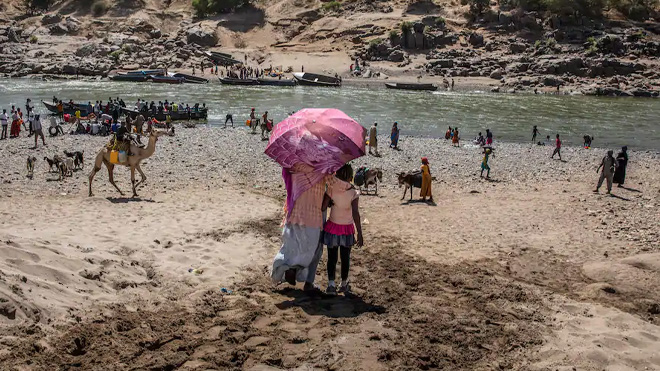
Mai-Aini Refugee Camp, Ethiopia — They crossed the border at midnight, grief-stricken at the death of their daughter the previous day. Gebre's two-year-old girl Arsama perished from the flu. The night after they buried her, Gebre, 28, and his wife Teka, 25, decided to make their way to Ethiopia.
Arsama's death was just one reason for their escape. Gebre was exasperated with seven years in the military - part of Eritrea's obligatory decades-long national service - with not even enough money to pay for food for his family. There seemed no end to the misery, Gebre recalled, here in Ethiopia.
Read more...
Eritrea is the world’s most-censored nation, ahead of countries including North Korea and Syria, the Committee to Protect Journalists said.
The three countries are joined in the top 10 by Iran and Equatorial Guinea, the New York-based organization said in a report on its website today. Reporters in Eritrea, a nation in the Horn of Africa which won independence from Ethiopia in 1993, are conscripted into their work and handed instructions on how to cover events, the group said. The last accredited foreign correspondent was expelled in 2007, it said.
“No foreign reporters are granted access to Eritrea and all domestic media are controlled by the government,” the committee said. “Ministry of Information officials direct every detail of coverage.”
Read more...
It might seem a daunting challenge to determine which of the world's repressive nations offers the least-free news media. We have so many to choose from - Iran, North Korea, Belarus ...
But you might be surprised by the unanimity among organizations that study such things, like Reporters Without Borders, a French group. The consensus choice is Eritrea, a tiny nation most people cannot even pinpoint on a map.
Eritrea, a desperately poor desert state about the size of Pennsylvania, lives in an ugly neighborhood on the Horn of Africa, between Sudan, Ethiopia and Somalia. But as tyrannical as the neighbors might be, Eritrea is in a league of its own. Conditions there are so bad that an estimated 25 percent of the population has fled over the past 20 years, even though the government classifies emigrants as "traitors," and border guards are ordered to shoot them on sight.
Read more...
*Reliable source informed ICER that over 600 Eritrean, children, men and women are kept in a ‘slave holding lots’ few kilometers west of Shegerab refugee camps. The story told by an Eritrean who is tirelessly fighting to stop the human trafficking by alerting new arrivals of the dangerous situation awaiting them if they are not careful and also by informing Sudanese authorities of the illegal activities going under their nose. His information sources are the escapee and animal herders around the holding areas where he has good rapport. It is known that the victims are held in about 12 homes, under shade of trees and in mountain caves guarded by Sudanese, Hadendwa and Beni Amer guards. The past two weeks human smuggling have become so brazen that it is done in daytime, at coffee shops and public places with no one to stop it. There are two reasons for that according to our source.
Read more...
ADDIS ABABA (Reuters) - Eritrea has sought to quash speculation about President Isaias Afewerki's health, saying he was "fit as a fiddle" and lambasting the United States for spreading "lies" over his condition.
Rumors have been rife in the past few years that Isaias, 66 and in power since 1993 after leading his country to independence from Ethiopia, was in poor health and required regular trips abroad for treatment.
Speculation about his health has stirred up debate over who might eventually replace the reclusive leader. Isaias has no obvious successor but the opposition says he might be grooming his son, Abraham, for the top job.
Read more...
Juba — Rebels fighting the South Sudan government are receiving weapons and ammunition from Sudan and Eritrea, says a report by Small Arms Survey; an independent research project in Geneva. ...
"In addition to Khartoum, Asmara [Eritrea] is emerging as a likely source [...] for weapons supplied to Southern rebels," the report claims.
Ammunition confiscated by the SPLA from the late George Athor's SSDM forces in Jonglei were identical to rounds were also found with Ogaden National Liberation Front (ONLF) reportedly supplied by Eritrea.
Read more...
HEGLIG, Disputed Sudan -- Nine months after Sudan split into two nations in search of a peace brokered by the United States, it is now clear that the two sides are at war.
Diplomats discussing the armed conflict talk of skirmishes and dustups, but a visit to this border region shows that what is taking place here is no accidental exchange of fire by troops confused about where the border lies. Instead, what’s happening is a headlong mobilization involving not just thousands of Sudan’s and South Sudan’s best forces and heaviest equipment, but heavily armed rebels from the distant Darfur region fighting alongside the South Sudanese troops.
Read more...
Reporters Without Borders has learned that the journalist Yirgalem Fisseha Mebrahtu, in custody since her arrest in February 2009, was admitted to hospital in the Eritrean capital Asmara earlier this year. The organization is extremely worried about her state of health and concerned about the conditions under which she is being held. ...
“The government of President Issaias Afewerki has already permitted the death in detention of at least four journalists. It issues no information on several others and it is not known whether they are still alive. Today, it is the life of Yirgalem Fisseha Mebrahtu that it is playing with.” ...
According to information reaching Reporters Without Borders, Mebrahtu is in serious condition in Asmara’s Halibet hospital.
Read more...
Council of Europe investigator says deaths of migrants adrift in Mediterranean exposes double standards in valuing human life. ...
Errors by military and commercial vessels sailing nearby, plus ambiguity in the coastguards' distress calls and confusion about which authorities were responsible for mounting a rescue, were compounded by a long-term lack of planning by the UN, Nato and European nations over the inevitable increase in refugees fleeing north Africa during the international intervention in Libya.
Read more...
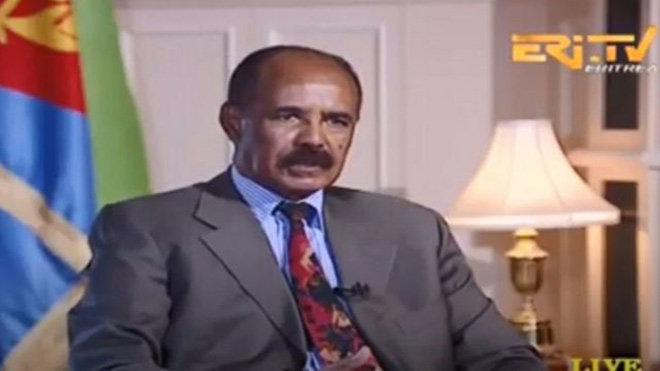
"We have seen several attacks, not just one. We prefer not to talk about it and don't intend to be involved in provocations," Isaias told Eritrean state TV in an interview late on Sunday that was later broadcast on the Internet.
"The military incursions were plotted by Washington with the aim of diverting attention from implementing the boundary commission's decision," he said.
Read more...
More: