[AI] Asmarino Independent

  • Create an account
    *
    *
    *
    *
    *
    Fields marked with an asterisk (*) are required.
You are here: Home News President of Eritrea dismisses allegations
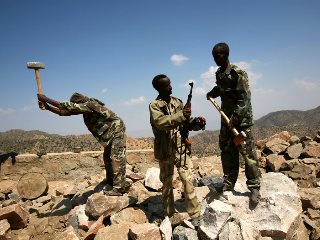
President of Eritrea dismisses allegations

Write e-mail Print
ASMARA, Eritrea -- In this lonely corner of the world, the first sign of distress is the luggage. When one of the few international flights that are still operating here touched down one recent afternoon, the returning passengers emerged from baggage claim as if from a big shopping trip. Old metal trolleys squealed under the weight of mundane items: tires, a laptop computer, tubs of detergent and duffel bags crammed so tightly with food that tin cans bulged through the fabric.

The needs are acute in Eritrea, a narrow shard of sand and rock along the Red Sea that's presided over by one of Africa's most secretive regimes. As its quixotic experiment in economic self-reliance falters, the Ohio-sized country of 5 million has slipped into its deepest political isolation in its 16 years of independence.

The United States and others accuse President Isaias Afwerki of funneling arms and money to Islamist insurgents in Somalia and have threatened to slap him with sanctions. Analysts say Isaias is bent on wresting influence from Ethiopia - Eritrea's large southern neighbor and adversary in a 30-year liberation struggle - and is backing several rebel groups across the chaotic Horn of Africa.

In a rare interview, Isaias dismissed the allegations as "fabrications" by Western interests - including his favorite bogeyman, the CIA - that traditionally have sided with Ethiopia. The pariah label has reinforced his belligerent attitude toward a world that long ignored Eritrea's cries for independence, and one in which he now seems to have just one remaining friend, the wealthy Persian Gulf emirate of Qatar.

"Why would you want to have allies?" the 63-year-old president told McClatchy Newspapers. "It's a sign of weakness."

A gruff, imposingly tall former guerrilla with a college professor's wardrobe and a Ron Burgundy moustache, Isaias helped lead the liberation war and has never let go of power. A decade after a devastating border flare-up with Ethiopia that remains unresolved, he has never held elections, banned opposition groups and independent media, and reportedly banished thousands of people to remote desert prisons where they languish without trial in "harsh and life-threatening conditions," according to a State Department human rights report last year.

In recent years, Isaias has seized U.N. World Food Program stockpiles and expelled or blocked most international relief organizations, claiming that his arid nation could produce enough food to feed all its people. Yet after consecutive poor harvests, and amid one of the worst hunger crises in East Africa in decades, the U.N. Food and Agriculture Organization warned last month that as many as two-thirds of Eritreans may be malnourished.

Isaias rejected the report - "We have no shortage," he said - but humanitarian groups say the government blocks them from accessing the areas that are thought to be the most affected. In the capital, Asmara, more and more children in frayed clothes and splotchy skin are begging on the streets, hinting at desperation in the countryside.

"A year or two ago, you never saw that," a diplomat said. "It means the safety net is failing."

Perched atop a 7,600-foot plateau, sun-bathed Asmara is one of the continent's safest and most alluring capitals, with wide, palm-fringed streets and splashes of colorful modernist architecture left over from Italian colonial rule. Below the surface, however, beats constant fear.

No Eritreans would be quoted by name criticizing the president. The government, which some have likened to an African North Korea, controls people's lives through a program of forced national service that requires all citizens to undergo military training and then assigns them indefinitely to army posts or civilian jobs, paying token wages.

Men and women younger than 50 rarely get permission to leave the country, effectively meaning that the entire able-bodied population is on reserve duty. People who resist the service routinely are imprisoned and tortured, as documented in a 96-page report this year by Human Rights Watch, which found that Eritrean authorities had issued shoot-to-kill orders for anyone caught trying to jump the border without permission.

"It's for generations that we're trying to build a nation and build an economy, and that requires sacrifice," Isaias said. "National service may not be liked by everybody, even by the government, but it's a necessity."

Yet even with these draconian measures, the country remains far from self-reliant. One-third of the economy, according to some estimates, consists of money sent home by Eritreans living overseas. The prodigious shopping on display at the airport - all carried by elderly travelers, the only ones eligible for exit visas - also suggests that Isaias' gambit is failing.

"People are losing patience every day," said a 44-year-old father of three who spent 12 years in the national service, including a stint as a soldier on the front lines during the 1998-2000 border war, when a bullet hit him in the back.

His conscript's salary was about $35 a month, and although the government provided small rations of goods such as coffee, sugar and cooking oil, he had to moonlight.

Isaias "always talks about sacrifice, sacrifice," the man said at a sidewalk cafe, lowering his voice when a waitress came near. "People are looking around and asking, 'What's the purpose?"'

It wasn't always so bleak. Following independence, Isaias pledged to institute multiparty democracy, and he oversaw the drafting of a progressive constitution. When the border dispute reignited, however, Isaias dramatically scaled up conscription and put all pretenses of democracy on hold.

When he was asked when he will hold elections, Isaias said, "We don't need elections."

More of the nation's youth seem to be abandoning hope. Despite the perils of fleeing, the United Nations refugee agency received 62,700 new asylum applications from Eritreans last year; only Zimbabwe produced more.

The bulk of the asylum-seekers, according to diplomats and independent human rights reports, are young army deserters and high-schoolers evading military training at Sawa, a prisonlike desert camp. Last May, the State Department reported, several apparent deserters were shot near the border with Djibouti.

"The defections have to be a concern for the regime," said Dan Connell, a lecturer at Simmons College in Boston who's written extensively on Eritrea. "One reason they instituted national service was to initiate the next generation into the culture of the liberation movement. The evidence suggests it's not working."

One afternoon in a dimly lit bar, a 25-year-old man nursed a beer and recalled a friend from his military service days who was arrested for saying critical things about the government. He was hauled off to prison and hasn't been heard from since.

That was three years ago. The man sighed and contemplated his own chances of escaping, perhaps to the United States.

"What's the best that anyone could hope for here?" he said. "It's not very much."


Add comment

Security code
Refresh

Asmarino

Eritrean Youth Call for Friday Protests Inside the Country

Eritrean Youth Call for Friday Protests Inside the Country

January 31, 2012 - Eritrean youth across the globe are calling their counterparts inside the country to demonstrate their outrage at the human and democratic rights abuses by emptying the streets in towns and cities throughout the country every Friday evening starting Friday 3rd of February. The call that has been transmitted through electronic communication and social media has so far been received positively by Eritreans inside the country.

Read more...

Eritrean-Ethiopian Frienship Forum

Eritrean-Ethiopian Frienship Forum

Ethiopian & Eritrean Friendship Forum (EEFF) is holding its fourth annual conference on March 24th, 2012. Building on last year’s success, this year’s theme is "Healing Past Wounds -- Building Our Future Together", a critical idea to focus on in this increasingly competitive global economy.

We are sending this announcement to the wider Ethiopian and Eritrean community for two reasons:
- to invite as many people as possible to attend the conference. Be part of the solution!
- to invite thought leaders to share their views as panelists.


Read more...

The son of a Priest thinks that God is his Uncle.

The son of a Priest thinks that God is his Uncle.

The demonstration called by Mr.  Kyriakakos et.al is not an isolated incident.  Even though on the surface it appears that it was in reaction to the WFP articles, but none the less it is not.  It was part and parcel of the series of demonstrations and seminars that suddenly erupted in the month of December 2011 called “Hizbawi Mekete” (National Rebuff) to object the sanctions on Eritrea that was being debated at the UNSC and show to the international community that the Eritrean government enjoys the full support of its people.  The instruction to demonstrate and hold public meetings and seminars was issued by the office of Mr. Yemane Gebreab, political advisor to the President of Eritrea and in charge of the “Hizbawi Mekete”.

Read more...

Melbourne Rally 2012: For How Long Can You Remain Silent in the Face of Oppression?

Melbourne Rally 2012: For How Long Can You Remain Silent in the Face of Oppression?

As in previous years, we call on the Diaspora communities living in the free world that have chosen to be silent in the face of oppression and the ever growing injustice committed against the Eritrean people to fight for the people's rights. We remind you that you are morally obliged and duty bound to speak for the Eritrean people and to stand-up against injustice. We remind you the freedom that you enjoy are the outcomes of sacrifices paid by people who believed in liberty, freedom, justice and democracy. So, why don’t you demand for the Eritrean people the same civil rights that you are relishing? We encourage you to be part of the struggle for democratic change?


Read more...

Support AI

Plea by Paris lawyer on behalf of journalists imprisoned in Eritrea: “Beautiful Asmara, denied its Jasmine Revolution”

Plea by Paris lawyer on behalf of journalists imprisoned in Eritrea: “Beautiful Asmara, denied its Jasmine Revolution”

Prisca Orsonneau, a Paris bar member and coordinator of the Reporters Without Borders Legal Committee, participated in the final of the Caen International Human Rights Advocacy Competition on 29 January. Her speech, entitled “Beautiful Asmara, denied its Jasmine Revolution,” was a plea on behalf of Swedish-Eritrean journalist Dawit Isaac and other journalists who, like him, have been held for more than ten years in Eritrea without being brought to trial.

Read more...

Norway-Eritrea deal on the cards

Norway-Eritrea deal on the cards

The Norwegian government will shortly be signing an agreement enabling forced return of rejected Eritrean asylum seekers, according to reports. ...

The UN High Commissioner for Refugees (UNHCR) and the UN High Commissioner for Human Rights (OHCHR) have both advised against return.

Human rights organisations report widespread physical abuse of political opponents. A prominent Norwegian researchers classifies the country as “one of the most totalitarian and militarised in the world,” reports Klassekampen.

Read more...

Ethiopian tourist abductions and attacks blamed on Eritrea

Ethiopian tourist abductions and attacks blamed on Eritrea

(eTN) - Eritrea’s dictatorial and radical regime has been fingered by Eritrean opposition groups, Ethiopian, and other international sources for alleged complicity in the recent spate of attacks on foreign tourists and abductions, as Ethiopian rebels granted safe havens inside Eritrea are suspected to have carried out the attacks.

A source in Addis Ababa, insisting on anonymity – not a strange demand considering the zipped-up attitude of the entire country vis-a-vis even friendly media – suggested that the rebels were aiming to disrupt the growing tourism business in Ethiopia to harm the country’ economy ...

Picture: Member of European tourist group attacked by terrorists from Eritrea

Read more...

Human Rights Watch World Report 2012: Eritrea

Human Rights Watch World Report 2012: Eritrea

Since September 2001 or even before, Eritreans from all walks of life—government officials, leaders of government-controlled labor unions, businesspeople, journalists, and national service evaders or escapees—have been jailed for explicit or inferred opposition to President Isaias Afwerki and his policies. The number of Eritreans jailed for such opposition is difficult to confirm, but ranges from 5,000 to 10,000, excluding national service evaders and deserters, who may number tens of thousands more. Twenty prominent critics and journalists have been held in incommunicado isolation for a decade; nine are feared dead.

Read more...

In 2012 Worldwide Press Freedom Index Eritrea Is Last: 179th

In 2012 Worldwide Press Freedom Index Eritrea Is Last: 179th

Finally, Eritrea (179th) came last in the index for the fifth year running. Freedom of opinion, like all the other freedoms, does not exist under the totalitarian dictatorship that President Issaias Afeworki has imposed on this Horn of Africa country. At least 30 journalists are currently detained in appalling conditions. Some have been held for more than 10 years.

At the other end of the index, several African countries made significant progress or showed that respect for freedom of information has taken a firm hold in their societies.

Read more...

Swedish court finds Tedros Issak guilty of unlawful threat against Meron Estifanos

Swedish court finds Tedros Issak guilty of unlawful threat against Meron Estifanos

Meron Estefanos appeared as a speaker at a Book Fair in Gothenburg on the day when the incident took place. She has written about Eritrea and about the family of Isaak. Meron Estefanos and Teodros Isaak were not personally acquainted. After Meron Estefanos’ speech, Teodros Isaak came up to her. He made comments on the publications she wrote about the family of Isaak, while she stated that she wrote what she wanted. There was thus an exchange of words between them. Meron Estefanos stated that the argument ended with Teodros Isaak who said that he would cut her throat if she wrote about them again. His daughter pulled him away.

Read more...

German hostages in 'good health': Ethiopia rebels

German hostages in 'good health': Ethiopia rebels

ADDIS ABABA — Ethiopian rebels said German tourists they seized last week were safe and blamed the government for the incident in which five Europeans were also killed on the slopes of a famed volcano.

Addis Ababa had blamed the region's worst attack on tourists in years on gunmen armed by arch-foe Eritrea but a rebel group claiming to fight for the Afar region and its people said the bloodshed occurred when government soldiers attacked one of its patrols.

Read more...

ŒCOCW Calls for International Religious Freedom for Exiled Eritrean Orthodox Patriarch

ŒCOCW Calls for International Religious Freedom for Exiled Eritrean Orthodox Patriarch

Of great significance is the extremely disrespectful manner in which the Patriarch of the Eritrean Orthodox Tewahdo Church, His Holiness, Abune Antoios, who was reportedly forcibly removed from his patriarchal residence and throne.  Since that time Patriarch Antoios has been reported to be illegally detained by government officials at an undisclosed location.  Patriarch Antoios’ major offense apparently was his strong resistance to Government intrusion into Church affairs such as his refusal to excommunicate three thousand members of the Medhane Alem, an Orthodox Sunday School movement.

Read more...

Islamist insurgents kill over 178 in Nigeria's Kano

Islamist insurgents kill over 178 in Nigeria's Kano

(Reuters) - Gun and bomb attacks by Islamist insurgents in the northern Nigerian city of Kano last week killed at least 178 people, a hospital doctor said on Sunday, underscoring the daunting challenge President Goodluck Jonathan now faces to prevent his country sliding further into chaos.

A coordinated series of bomb blasts and shooting sprees mostly targeting police stations on Friday sent panicked residents of Nigeria's second biggest city of more than 10 million people running for cover.

The scale of the carnage makes this by far the deadliest strike claimed by Boko Haram, a shadowy Islamist sect that started out as a clerical movement opposed to western education but has become the biggest security menace facing Africa's top oil producer.

Read more...

Forgotten: The stolen people of the Sinai

Forgotten: The stolen people of the Sinai

TLS: A 19-year-old Eritrean woman:

"When I was still in Sudan, I agreed to pay the smugglers $2,500 to transfer me to Israel. When I arrived in Sinai, the smuggler sold me, along with a group of other people, to another smuggler named Abdullah. Abdullah demanded an additional $10,000 from me. I had no way to raise that sum of money. Abdullah raped me for five days and two other smugglers raped me as well. As a result of all these rapes, I got pregnant. Only after eight months was my father able to send the smugglers $5,000; they released me and allowed me to cross the border to Israel. I must have an abortion. My husband should not know what happened to me in the desert."

Read more...
More:


Buying Time Eyewitness Account Blood Money News Analysis Editorial Writers' Corner News Articles Press Releases Latest